It helps to demonstrate the potentially far-reaching consequences of what might, at first sight, appear to be an isolated or relatively small problem.
Tim Winters, National Engineering Contracts Manager, Prudential UK
Founded in London in 1848 Prudential is a leading life and pensions provider in the UK. Its UK Insurance Operations provide a range of financial products and services including annuities, corporate and individual pensions, with-profits bonds, savings and investment products and Individual Savings Accounts (ISAs) to around seven million customers. The business currently employs some 7,400 staff located in offices in Stirling, Reading, Belfast, London, Dublin and Mumbai, India.
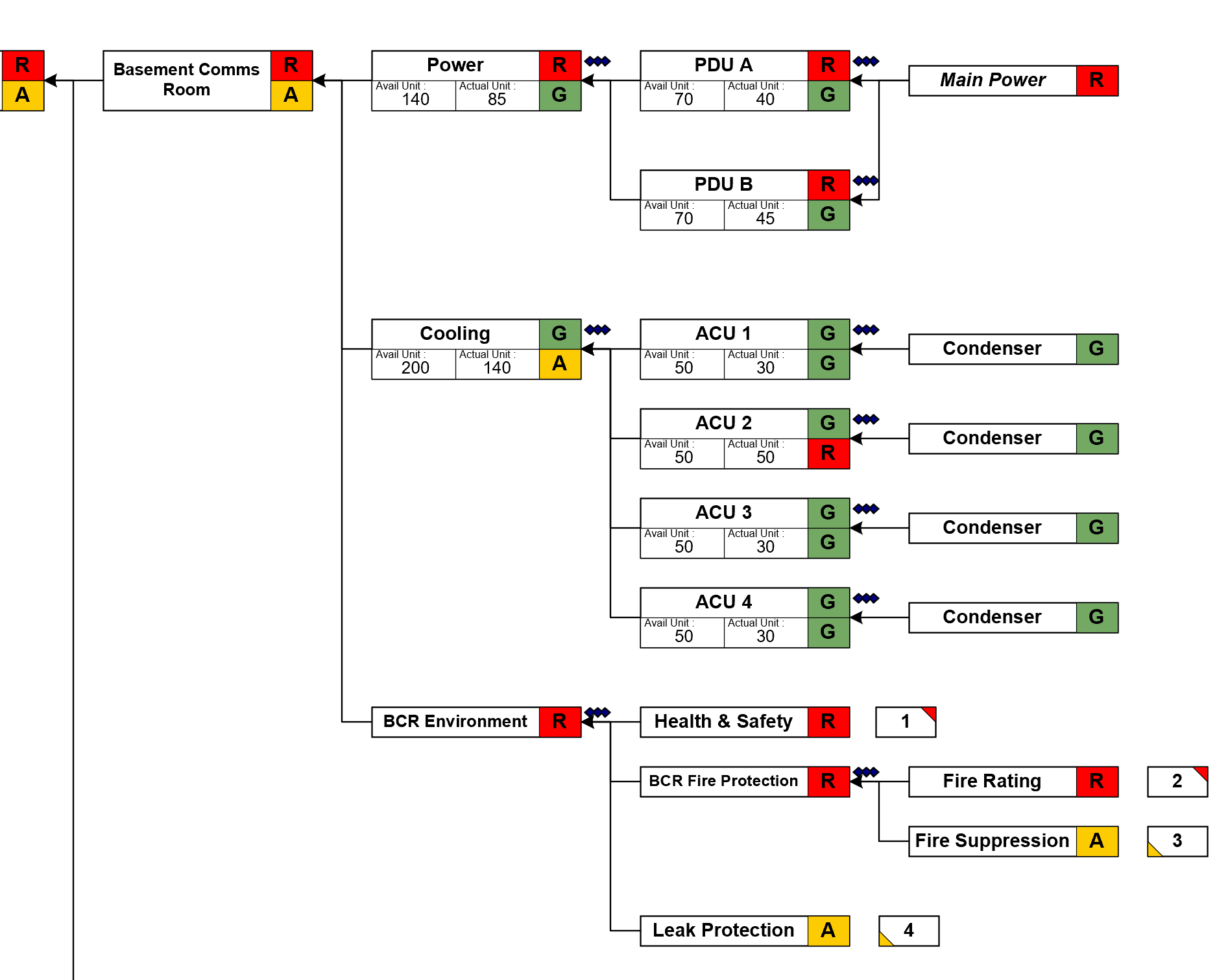
A key element in helping the business to run smoothly and effectively is ensuring that all the everyday facilities on which it depends are properly deployed and fully operational. These facilities include the buildings themselves, power, heating, lighting, lifts and so on. At The Prudential in the UK Tim Winter, National Engineering Contracts Manager is responsible for these facilities and works with external suppliers to provide this support service to the Prudential.
The Business Challenge
On day-to-day issues Tim Winter and his team have the budget and the authority to simply take whatever actions are needed to keep the Prudential’s facilities running smoothly. The challenge comes when major expenditure is required to replace or refurbish buildings or equipment, which are a cause for concern, i.e. they are no longer adequate to service the organisation’s needs because they have insufficient capacity or because they have become prone to breakdown. The senior management to whom Tim Winter must present his case are extremely busy, with a range of responsibilities that include core business issues. The problem is compounded because those senior managers are generally not technical people. Their area of expertise is the financial services industry. Any tool or technique that can help them to make the right decisions more quickly is invaluable.
It is therefore essential to demonstrate the issues to these managers clearly, concisely and non-technically and even more importantly, to convey the consequential effects of particular purchasing and maintenance decisions. For example, if the number of staff occupying a given office space increases beyond the levels anticipated at the planning stage, the air conditioning plant may no longer be adequate to control the environment on those days when the outside temperature rises above 26°C. The result will be that productivity will decline and sickness will increase. This in turn will have an impact on the bottom line, because there are insufficient people available to take customers’ calls, process paperwork, etc.
The VRA Solution
Dependency Modelling (DM) is a method of demonstrating the critical issues clearly and precisely. It quite simply breaks down, any operation, strategy or project to show each step and the factors on which it depends, in other words its dependencies. The output of all this analysis is a tree diagram showing how the dependencies relate to each other. It also provides a framework for managing risks.
Creating Immediate Impact
Microsoft Visio-based Visual Risk Analyser (VRA) is a dependency-modelling tool, which is very easy to use. More critically, the management level presentation generated by the dependency model creates an immediate impact. There is no need to explain complex diagrams; the message is obvious and clearly understandable to busy, non-technical managers. High-risk status is show by a red traffic light against the asset, which is at risk and to the building systems, which are dependent on it. As Tim Winter remarked, ‘The visual impact of the VRA model is undeniable. Everyone understands the significance of red as a danger signal. The real value of VRA, however, is that it also turns all the other systems and equipment that depend on the at-risk asset, red. It helps to demonstrate the potentially far-reaching consequences of what might, at first sight, appear to be an isolated or relatively small problem.’
‘In addition, VRA helps us with our regular monthly reporting to senior management who need to assess all potential risks to the Prudential’s business. VRA enables us to present this information in a very easily comprehensible form, which, almost at a glance, lets management know whether there are risks that have to be dealt with and whether there are risks that exist, but which are currently being managed.’
Extending the Model
The reception from management has in fact been so positive that there is already a pull developing to expand VRA’s use. The existing models might demonstrate that there is a problem with the power supply and the engineering impact of this. Prudential are exploring the possibility of extending the model to demonstrate the impact on the business. By working with colleagues from the business side, Tim Winter believes it will be possible to build such an extension, so that a power outage is translated into business impacts such as the percentage of customers who will be unable to contact the company or a late payroll. At this point, the VRA model will really be talking the language of management, making VRA even more effective as a communications and decision-making tool than it already is.
Equally, the model is very valuable in helping in the management of the Prudential Partners who are responsible for the maintenance and upgrade of the facilities. The model helps to focus them on priorities.
Rapid Implementation
The VRA dependency models are very easy to generate and maintain. It takes perhaps a day to model one of the Prudential buildings, although the task of gathering and verifying the information to populate the model does take a little longer. In the case of the two buildings that have so far been modelled the task took about four weeks, tapping into the knowledge of the experienced team at the Prudential, plus some survey work. Tim Winter expects other buildings to take less time, because the team has now really understood how dependency modelling works and the relationships between different building assets. This had to be worked out from scratch on the first two projects, but it will be the same or very similar for the third and subsequent buildings.
In general however the recognition of how VRA works and its benefits come very quickly. A further encouragement to its use has been the ability to import existing MS Excel-based information into the model without re-keying. As Tim Winter commented, ‘Engineers want to do engineering, not fill in forms. If we had provided a new category of form to be completed I think we would have had some resistance, but they are already familiar with populating spreadsheets. So, what we have effectively done is give them a great piece of software that expands on something they have been doing for years and turns it into a new, powerful and inherently more useful format.’
Making Working Lives Better
The ability to publish VRA models as web pages will be important for the delivery team of 30-40 people, who often never see each other because of shift working. It enables them to share information rapidly and conveniently. At senior management level there is still a requirement to produce paper-based reports. However, VRA allows all the key information to be presented on a single page, replacing the bundles of complex information that so often fail to make the requisite impact.
Benefits
Improved Presentation
VRA allows users to create a single model, which can effectively be viewed through different windows. At the top end, the presentation level, it provides a corporate view of the whole organisation, with the risk status clearly signalled by the use of the well-understood red-amber-green traffic light analogy. With VRA the Facilities Management team are able to very quickly engage senior management attention and get the decisions necessary to remove risk.
Management Support
Downstream VRA helps to manage the partners responsible for carrying out the work on the facilities. The contractors can be made aware of the priorities very simply. Similarly, Tim Winter’s team can tell at a glance whether the risks are being reduced. More importantly it can help to align the partners with the Prudential’s wider business objectives, so that they too understand the priorities for the business. Tim Winter believes that this ultimately will lead to a much better and more productive relationship with partners, because everybody is ‘singing from the same hymn sheet’, satisfying the customers’ needs. This transforms the relationship with the supply partner into a genuine partnership.
The ultimate aim is that the partner will populate the risk models, publish them and discuss them with the Facilities Management team at the Prudential on a monthly basis. Far from being sceptical, once they were shown the VRA model, the contracting partners were so impressed that they already looking to roll VRA out into other organisations for whom they provide building services. They see VRA as a solution to a contractual obligation, which requires a partner, within the first 90 days of contract, to tell the Prudential about anything they think is risky. This is as much a protection for the partner as anything else, so that they are not penalised at some future date for problems that they inherited. It is also a powerful way of getting Tim Winter’s attention, in exactly the same way that he uses VRA to engage his senior management.
Indeed, Tim Winters and his team intend to use the VRA risk model as a Key Performance Indicator (KPI), which will form a service deliverable.
Ease of Use
VRA models can be generated very quickly once the data on the facilities has been collected and verified. This in itself is a useful discipline, ensuring that all the necessary information has been collected and that it does represent the very latest situation. Once this task has been completed, maintenance of the model takes very little effort. As replacement, refurbishment and maintenance take place, the information is updated in the model, ensuring that it remains a true and accurate representation of the situation.
Ease of use, minimal training and the ability to populate VRA models from existing Excel spreadsheets has been an enormous plus factor in gaining acceptance of the new software. Users readily appreciate that they are getting huge benefits for a very minimal effort.
Changing Attitudes
VRA has the potential to change the way that Facilities Management see their task. They are beginning to think about the broader business objectives, rather than simply their own, rather narrower property objectives. The positive benefits to the business in such a change of attitudes leads to a better working relationships and a more proactive approach to dealing with building problems. Facilities Management become fully engaged in meeting business objectives.
Rationalising Information Repositories
The ability of the model to include so much information, while keeping top-level presentations so simple, means that many other supporting information repositories can be pensioned off and all the key technical delivery information can be channelled through a single document, the VRA model. The VRA model becomes the bible that provides a range of information – management presentations, monthly reports, risk mitigation and management status, contractor monitoring, etc.
Related Posts
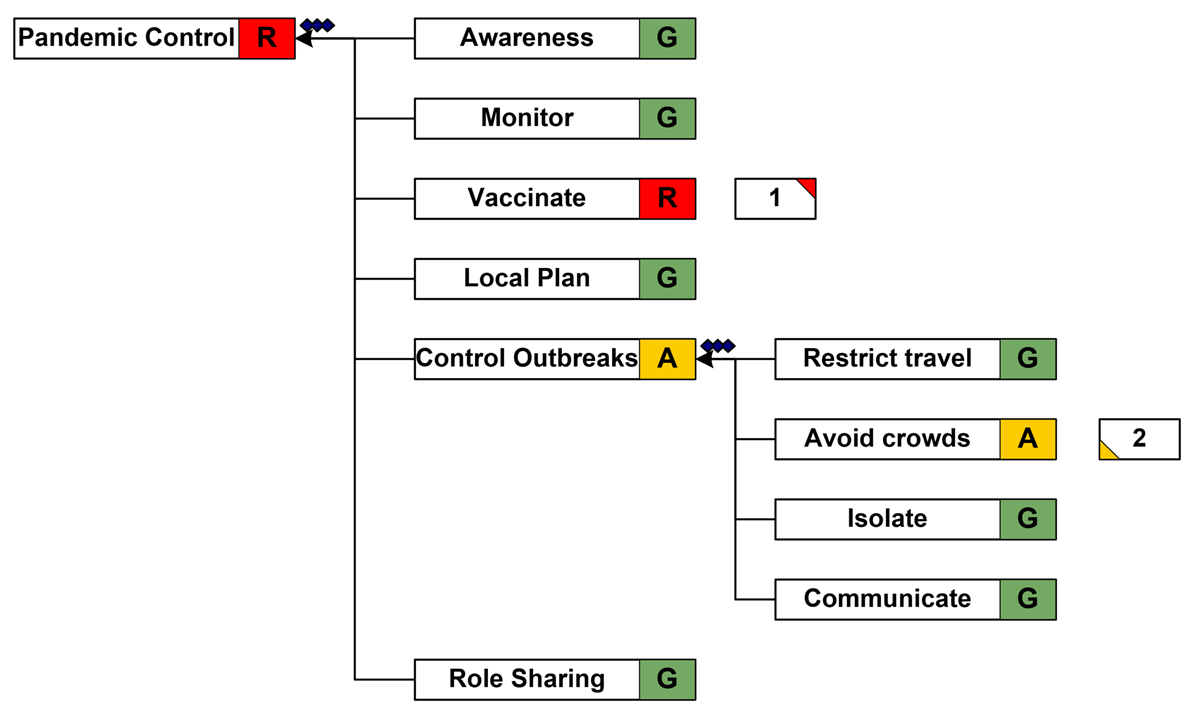
Visual Risks of a Global Pandemic
Back in the early noughties, I was part of a start-up company to to visualise the risks of any dependency system. We used Visio, of course, to map operational components and assets into a hierarchy of dependencies that simply displayed the roll-up of perceived risk. One of the demonstration diagrams that we (mainly Humphrey Tizard)…